
AI in Human Resources
Artificial intelligence is changing how companies recruit, develop and manage people. We explore where AI can genuinely ease HR workloads, which risks remain and how to get started responsibly.

What benefits does AI offer in HR?
HR teams traditionally struggle with the same three issues: inefficient processes, subjective decisions and a lack of data analysis for strategic planning. This is exactly where artificial intelligence comes in.
Automated processes
Routine tasks run in the background, giving your team more time for meaningful advisory work.
Objective data analysis
Decisions become transparent and evidence-based rather than relying on instinct alone.
New insights
Patterns in employee behaviour that were previously out of reach.
AI in HR: practical examples
AI for routine tasks
With ChatGPT and similar tools, HR professionals can handle a wide range of tasks much faster:
- Drafting emails: bullet points become finished messages – in the style of your own templates.
- Coordinating meetings: scheduling tools match availability and suggest suitable slots.
- Creating presentations: structure, content and visuals for formats of every kind.
- Transcribing & summarising: built into Teams or via external tools – the language model handles the summary.
AI in recruiting
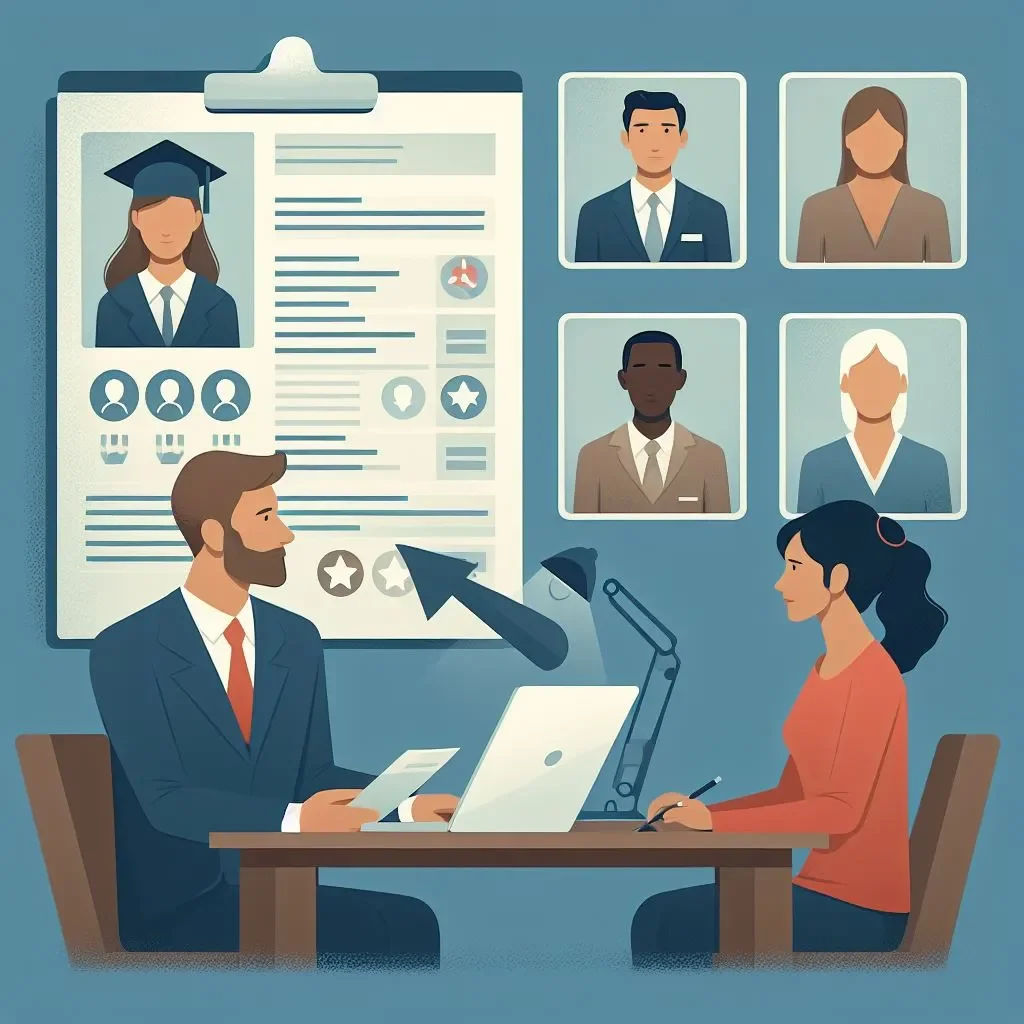
AI is changing how companies find, engage and hire talent by automating time-consuming steps, improving candidate sourcing and making selection processes more structured.
- Automated sourcing: tools search profiles on job boards, social media and other platforms to identify suitable candidates.
- Reducing bias: candidates can be assessed against skills and experience rather than demographic factors such as gender, age or background – provided the system itself is carefully designed and monitored.
- Efficient screening: thousands of CVs are pre-sorted against the role profile in seconds.
- Virtual assistants: answer candidate questions and keep the process moving.
Engagement & development
Employee engagement and continuous development have become key priorities. AI provides three concrete levers:
Personalised learning paths
Learning plans tailored to individual skills, interests and career goals while remaining aligned with company objectives.
Measuring engagement
Regular AI-assisted surveys can reveal sentiment and emerging trends through partly or fully automated analysis.
Suggesting career paths
Performance data and employee preferences can inform personalised recommendations for internal development.
Predictive analytics & strategic planning
AI-powered predictive analytics can help companies optimise workforce planning and make better-informed strategic decisions, from forecasting employee turnover to succession planning.
Used responsibly, AI does not replace human judgement in HR – it can make decisions faster, better supported by evidence and fairer.
What AI risks exist in HR?
Using AI in HR raises questions. The risks fall into three overarching categories:
Lack of transparency
Bias from training data and decisions nobody can explain.
Misinformation
Incomplete or skewed data can produce inaccurate assessments and analyses.
Data privacy
Sensitive people and company data need clear technical and organisational boundaries.
Transparency when using algorithms
AI tends to reproduce bias from its training data – and can reinforce existing inequalities. This is compounded by algorithms whose decision paths are hard to follow. The EU has therefore introduced regulations requiring transparent, explainable decision processes for AI applications in HR. That may sound daunting at first, but with a careful approach it is not a reason to hold back.
Inaccurate AI outputs
AI systems learn from the data they receive. If that data is incomplete, skewed or inaccurate, the results will be too – potentially leading to unreliable candidate assessments and unjustified HR decisions. High-quality, representative data and regular human review of outputs are therefore essential.
Data privacy & individual rights
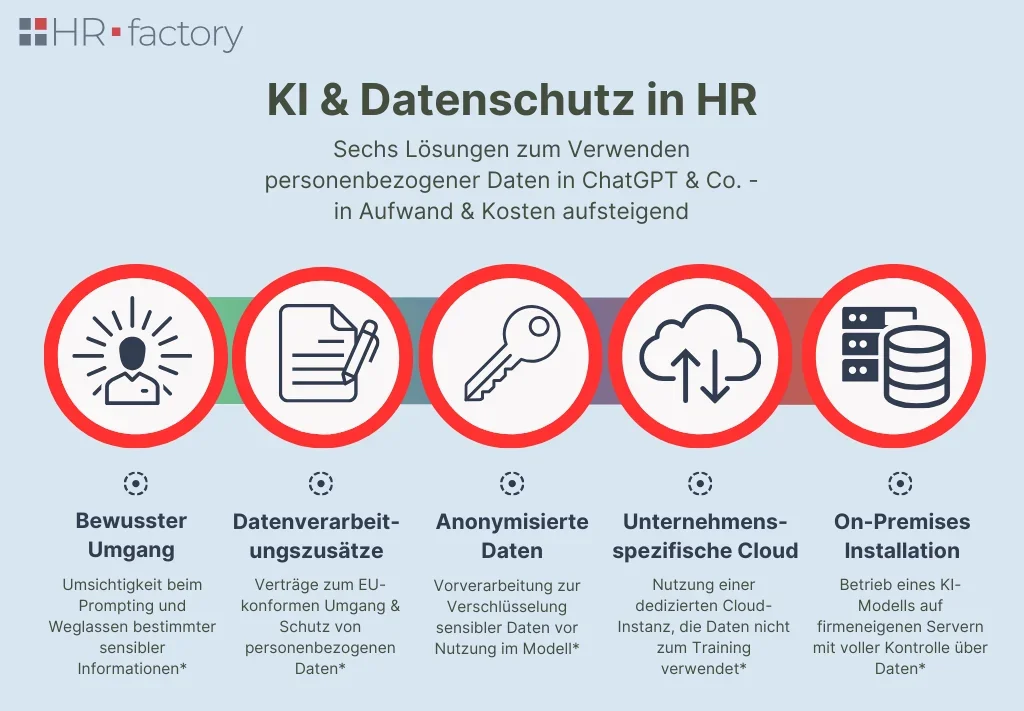
Concerns about sensitive data hold many companies back, and caution is justified. However, both technology and responsible working practices can reduce the risks: from using ChatGPT and similar tools carefully, to data processing agreements and anonymisation, through to private cloud environments and on-premises installations. The required investment varies considerably.
AI training for HR & consulting
Most HR departments in Germany have yet to receive training on using AI effectively. We help close that gap in two ways.
AI training for HR teams
Practical small-group workshops covering a range of use cases for ChatGPT and similar tools across HR – tailored to your department.
Book a free consultationAI consulting for leaders
The market for AI solutions can be difficult to navigate. We identify opportunities for people and technology, initiate change and support its implementation.
Book an initial consultationSupports HR teams through AI workshops and the selection of suitable tools – from their first prompting exercise to a privacy-compliant rollout.